
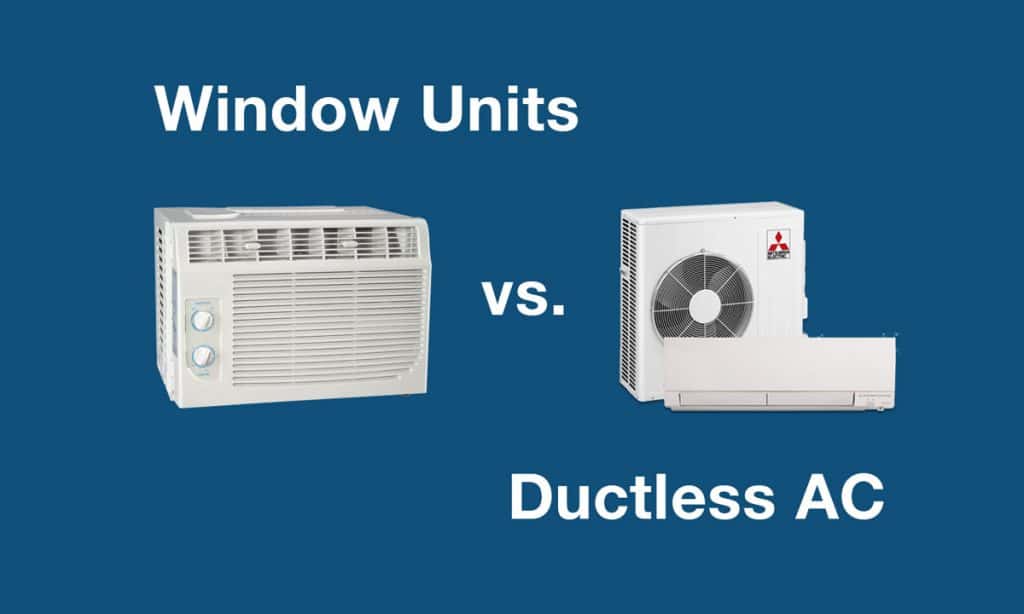
If you’re looking for a new air conditioner, there are a lot of options. If you don’t have ducts and don’t want to add them, you have two main choices: window units and ductless AC. Both can cool at least one room, neither require ducts, but which is the best option?
Here’s a brief guide to the main differences between window units and ductless systems.
What Is a Window Unit?
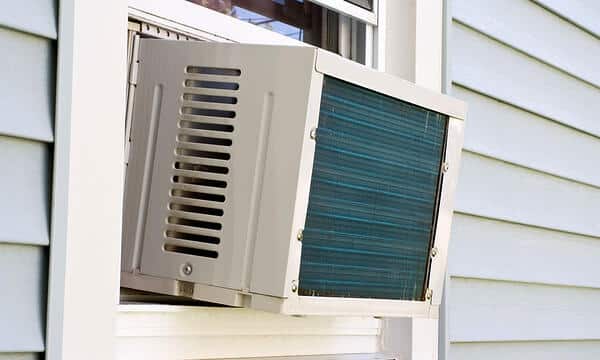
A window air conditioning unit fits into a window frame or an opening in the wall and it provides cooling for a single room. These units have several temperature and fan settings so you can adjust them according to your needs, and many units let you just use the fan feature without turning on the air conditioning mode. Generally, window AC units have internal thermostats, and they run until they sense that the air in the room has cooled down to the appropriate level.
They are relatively easy to install on your own, but they can be noisy and difficult to control accurately.
What is a Ductless System?

Also called a mini-split, a ductless system consists of both indoor and outdoor components. The outdoor part houses the compressor and the condenser, while the indoor unit handles the cool air. Tubing carries refrigerant, electricity, and communication signals between these two components. Just like all other air conditioners, the refrigerant absorbs heat from inside the building and releases it outside.
Window AC Unit vs. Ductless System
If you are trying to choose between a window air conditioner or a ductless system, here are some of the main factors you should consider:
Security

No matter where you install a window air conditioner, it compromises the security of your home or business. Intruders simply need to hoist the system out of the way to gain entry into the building. With a ductless AC system, the installation contractors only need to drill small holes in your outdoor walls in order to connect the suction lines, refrigerant lines, and power cables. That means that you don’t have to worry about your ductless system creating a security risk in any way.
Convenience

When you install a window air conditioner, you lose the benefits of having a window. You can’t open the window to bring in fresh air, and you may even have to sacrifice a great view. In contrast, ductless systems can be placed nearly anywhere on your interior wall or ceiling. Additionally, window air conditioners are often considered to be temporary cooling solutions. Even people who use them year after year tend to take them down in the winter, and that can be time consuming and annoying. Ductless units are a permanent feature.
Flexibility

Window air conditioners are designed to cool a single room, and to cool multiple spaces or large areas, you need to buy multiple units. In contrast, a ductless system let you pair multiple indoor units with a single outdoor unit, and you can control all of the units separately. To increase your options, the indoor units come in a wide range of different designs, so you can customize your set-up to work with your space. Ductless systems also feature reversible heat pumps and are also capable of providing heat.
Energy Efficiency

When it comes to energy efficiency, ductless systems are clearly the winners. Some window air conditioning units come with ENERGY STAR® ratings, but the SEER ratings on many mini-split systems are much more efficient. In addition, window air conditioners also tend to have a lot of air leaks — gaps between the unit and the window frame are practically unavoidable.
Easy Installation

The absence of ductwork makes ductless systems relatively fast and easy to install. There is no need to tear down walls or do major renovations, and most contractors can handle small installations in a day or so. For large installations with multiple indoor and outdoor units, you can even opt to do the installation in zones so that you don’t have to shut down all of your operations.
Cost

If you don’t have existing ductwork, the cost of ductless is considerably less expensive than putting in a central HVAC system. In cases, where the ductwork is already in place, however, ductless systems may be slightly more expensive than just buying a new central air conditioner.
However, installation is only the first cost to consider. You should also consider energy efficiency, and in most cases, ductless systems are cheaper to run long-term. Beyond that, you never have to worry about cleaning the ducts when you have a ductless system, and that adds to the overall savings.